 PmaControl
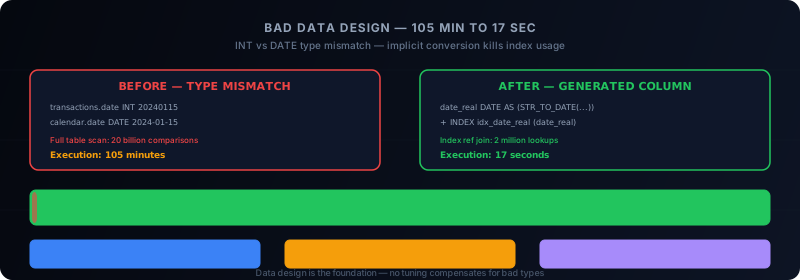
The Symptom: 105 Minutes for a Query
A client calls me urgently. Their nightly batch, which feeds daily reports, is taking longer and longer. What used to run in 10 minutes a year ago now takes 105 minutes. Volume has increased, certainly, but not enough to justify a tenfold increase in execution time.
The offending query is a classic JOIN between a transactions table and a calendar table:
SELECT
    t.transaction_id,
    t.amount,
    t.transaction_date,
    c.fiscal_year,
    c.fiscal_quarter
FROM transactions t
JOIN calendar c ON t.transaction_date = c.calendar_date
WHERE t.created_at >= '2024-01-01';
Nothing remarkable at first glance. Two tables, a join on a date, a time filter. And yet, 105 minutes.
The Diagnosis: A Type Mismatch
The execution plan analysis (EXPLAIN) reveals a full table scan on the calendar table. Strange for a join on what should be a primary key.
Examining the table structures, the problem jumps out:
-- transactions table
CREATE TABLE transactions (
    transaction_id BIGINT AUTO_INCREMENT PRIMARY KEY,
    amount DECIMAL(10,2),
    transaction_date INT NOT NULL,  -- stored as YYYYMMDD
    created_at DATETIME
);

-- calendar table
CREATE TABLE calendar (
    calendar_date DATE NOT NULL PRIMARY KEY,
    fiscal_year SMALLINT,
    fiscal_quarter TINYINT
);
The transaction_date column in the transactions table is an INT storing the date in YYYYMMDD format (for example, 20240115 for January 15, 2024). The calendar_date column in the calendar table is an actual DATE.
When MariaDB / MySQL executes the JOIN, it must compare an INT with a DATE. For each row in transactions, the engine implicitly converts the DATE to an INT (or vice versa) for every row in calendar. This implicit conversion makes the index on calendar_date unusable. Result: a full table scan on calendar for every row in transactions.
With 2 million transactions and 10,000 rows in calendar, that is 20 billion comparisons with type conversion.
Why Not Simply Change the Type?
The obvious answer would be to convert the transaction_date column from INT to DATE. But in the reality of production systems:
- The table is 15 GB. An
ALTER TABLEwould take hours and lock the table. - 47 stored procedures and 12 views reference
transaction_dateasINT. - The PHP application uses arithmetic comparisons on this column (
WHERE transaction_date > 20240101). - The ETL loading batch sends dates in
INTformat from a legacy system.
Changing the type is the right long-term solution, but not the immediate fix the client needs tonight.
The Solution: A Virtual Generated Column
MariaDB / MySQL supports virtual columns (or generated columns). These are columns dynamically computed from other columns, without physical storage (VIRTUAL) or with storage (STORED).
ALTER TABLE transactions
ADD COLUMN transaction_date_real DATE AS (
    STR_TO_DATE(CAST(transaction_date AS CHAR(8)), '%Y%m%d')
) VIRTUAL;
This column converts the INT to DATE on the fly. But a virtual column alone does not solve the performance problem. An index is needed:
ALTER TABLE transactions
ADD COLUMN transaction_date_real DATE AS (
    STR_TO_DATE(CAST(transaction_date AS CHAR(8)), '%Y%m%d')
) STORED,
ADD INDEX idx_transaction_date_real (transaction_date_real);
We use STORED rather than VIRTUAL to be able to create an index. The column is physically stored and the index is automatically maintained during inserts and updates.
The Corrected Query
SELECT
    t.transaction_id,
    t.amount,
    t.transaction_date,
    c.fiscal_year,
    c.fiscal_quarter
FROM transactions t
JOIN calendar c ON t.transaction_date_real = c.calendar_date
WHERE t.created_at >= '2024-01-01';
The JOIN now compares a DATE with a DATE. The index is usable. The execution plan shows a ref instead of a full scan.
The Result: 17 Seconds
| Metric | Before | After | Improvement |
|---|---|---|---|
| Execution time | 105 min | 17 sec | 99.7% |
| Rows examined | ~20 billion | ~2 million | 99.99% |
| Scan type | Full scan | Index ref | — |
From 105 minutes to 17 seconds. A 99.7% improvement without changing the existing schema, without modifying the application, without touching stored procedures.
Why Implicit Conversions Are a Trap
This case illustrates a fundamental problem: implicit type conversions in joins and WHERE clauses are silent performance killers.
MariaDB / MySQL performs implicit conversions in many cases:
INTcompared toVARCHAR: the INT is converted to VARCHARINTcompared toDATE: the DATE is converted to a numberVARCHAR(utf8)compared toVARCHAR(latin1): charset conversionDECIMALcompared toFLOAT: floating-point conversion
In each case, the conversion makes the index unusable because the engine cannot do a direct B-tree index lookup if the value must first be transformed.
The Lesson: Data Design Is the Foundation
Database performance is determined at design time, not at tuning time. No index, no buffer pool configuration, no hardware will compensate for a bad data type choice.
The fundamental rules:
- A date must be stored as
DATEorDATETIME, never asINTorVARCHAR. - Join columns must have the same type and the same charset/collation.
- Use
EXPLAINsystematically to verify that your joins use indexes. - Watch for implicit conversions with the
EXPLAIN ANALYZEtool (MariaDB 10.1+).
Data design is not glamorous. It is not as exciting as tuning system variables or setting up a Galera cluster. But it is the foundation. And when the foundation is bad, everything else crumbles — 105 minutes at a time.
This article was originally published on Medium.
Comments (0)
No comments yet.
Leave a comment