 PmaControl
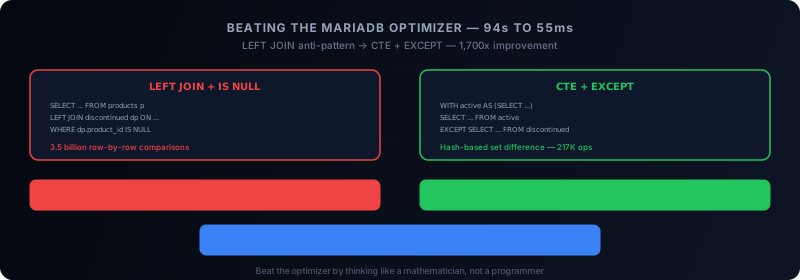
The Context: MySQL 8 to MariaDB 11.4 Migration
A migration project from MySQL 8 to MariaDB 11.4 is going well overall. Functional tests are green, performance tests too — except for one query. A single query that ran in 2 seconds on MySQL 8 and now takes 94 seconds on MariaDB 11.4.
This is a classic migration regression: the MySQL and MariaDB optimizers have diverged significantly since the fork. An execution plan that worked well on one can be catastrophic on the other.
The Problematic Query
The original query uses the classic LEFT JOIN pattern to find records that do NOT exist in another table:
SELECT p.product_id, p.product_name, p.category_id
FROM products p
LEFT JOIN discontinued_products dp
    ON p.product_id = dp.product_id
    AND p.category_id = dp.category_id
WHERE dp.product_id IS NULL
  AND p.status = 'active'
  AND p.created_at >= '2023-01-01';
The intent is clear: find all active products that do not appear in the discontinued products table. It is an "anti-join" pattern implemented via LEFT JOIN + IS NULL.
Why 94 Seconds?
Analyzing the execution plan on MariaDB 11.4 reveals the problem. The optimizer chooses to:
- Scan the
productstable using the index onstatus(200,000 rows) - For each row, scan the
discontinued_productstable to verify the absence of a match
With a discontinued_products table of 17,500 rows, this represents approximately 3.5 billion comparisons. The MySQL 8 optimizer chose a different plan with a hash join, much more efficient for this pattern.
The fundamental problem is not the MariaDB optimizer — it is the query itself. LEFT JOIN + IS NULL to implement an anti-join is a historical anti-pattern dating from the era when SQL had no better alternatives.
The Solution: CTE + EXCEPT
MariaDB has supported Common Table Expressions (CTE) since version 10.2 and the EXCEPT operator since version 10.3. These two features allow rewriting the logic in a much more explicit way:
WITH active_products AS (
    SELECT product_id, category_id
    FROM products
    WHERE status = 'active'
      AND created_at >= '2023-01-01'
),
still_active AS (
    SELECT product_id, category_id FROM active_products
    EXCEPT
    SELECT product_id, category_id FROM discontinued_products
)
SELECT p.product_id, p.product_name, p.category_id
FROM products p
JOIN still_active sa
    ON p.product_id = sa.product_id
    AND p.category_id = sa.category_id;
Why It Is Faster
-
The
active_productsCTE materializes the 200,000 active products in memory. A single scan of theproductstable. -
The
EXCEPToperator performs a set operation: it takes the set of active products and subtracts those appearing indiscontinued_products. It is a hash-based set difference, not a row-by-row comparison. -
The final JOIN with the
still_activeCTE is a simple lookup on an already filtered set.
The Result: 55 Milliseconds
| Metric | LEFT JOIN | CTE + EXCEPT | Improvement |
|---|---|---|---|
| Time | 94 seconds | 55 ms | 1,700x |
| Comparisons | ~3.5 billion | ~217,500 | 99.99% |
| Approach | Row by row | Set-based | — |
From 94 seconds to 55 milliseconds. A factor of 1,700. Not by changing a configuration parameter. Not by adding an index. By rethinking the query logic.
The LEFT JOIN Anti-Pattern: Why It Persists
The LEFT JOIN + IS NULL pattern for anti-joins is everywhere. You find it in tutorials, online courses, Stack Overflow answers. It persists for several reasons:
Historical: Before SQL:1999, there was no EXCEPT, no optimized NOT EXISTS, no CTE. LEFT JOIN + IS NULL was the only portable option.
Habit: Developers learn a pattern that works and reuse it. "It works" is the enemy of "it is optimal."
Compatibility: LEFT JOIN works on all versions of all databases. EXCEPT is only supported by recent versions.
Alternatives to Know
For anti-joins, three alternatives exist:
NOT EXISTS (often the best choice)
SELECT p.product_id, p.product_name, p.category_id
FROM products p
WHERE p.status = 'active'
  AND p.created_at >= '2023-01-01'
  AND NOT EXISTS (
    SELECT 1 FROM discontinued_products dp
    WHERE dp.product_id = p.product_id
      AND dp.category_id = p.category_id
  );
NOT EXISTS is generally well optimized by both MariaDB and MySQL engines. The optimizer can use an inverted semi-join, much more efficient than a LEFT JOIN.
NOT IN (beware of NULLs)
SELECT product_id, product_name, category_id
FROM products
WHERE status = 'active'
  AND created_at >= '2023-01-01'
  AND (product_id, category_id) NOT IN (
    SELECT product_id, category_id
    FROM discontinued_products
  );
Caution: NOT IN has tricky behavior with NULL values. If discontinued_products.product_id can be NULL, NOT IN semantics return an empty result. Always use NOT EXISTS if NULLs are possible.
EXCEPT (the most readable)
SELECT product_id, category_id FROM products
WHERE status = 'active' AND created_at >= '2023-01-01'
EXCEPT
SELECT product_id, category_id FROM discontinued_products;
EXCEPT is the purest expression of the set operation "A minus B." But it only returns the columns of the operation, not additional columns — hence the use of a CTE to reintroduce missing columns via a JOIN.
The Lesson
The optimizer is a tool, not a miracle worker. When a query is slow, the first question should not be "what hint can I add?" or "what parameter should I change?" The first question should be: does my query correctly express my intent?
A LEFT JOIN + IS NULL expresses "join then filter non-matches." An EXCEPT directly expresses "subtract this set from that other set." The second formulation is closer to the business intent, and it gives the optimizer a much better chance of finding an efficient plan.
Beat the optimizer by thinking like a mathematician, not a programmer.
This article was originally published on Medium.
Comments (0)
No comments yet.
Leave a comment