 PmaControl
The problem
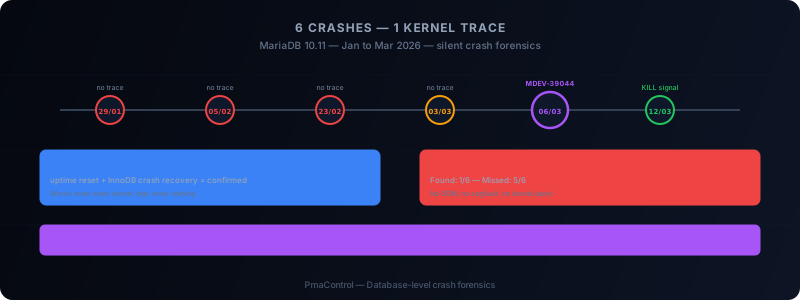
Between January and March 2026, we observed 6 abnormal uptime resets on a production MariaDB 10.11.15 server monitored by PmaControl. The server hosts very large partitioned RocksDB tables (time-series metrics).
A DBA's classic reflex when facing a crash: check the system logs. journalctl, dmesg, /var/log/syslog. Look for OOM, Killed process, segfault, kernel panic.
Out of 6 crashes, only one had an exploitable kernel trace. The other 5: complete silence from the system side.
Detection method
Rather than trusting system logs, we used PmaControl to detect crashes via the uptime time series:
- Retrieve
uptimevalues fromts_value_general_int - Filter abnormal resets (uptime dropping back to 0)
- Correlate with MariaDB logs (
error.log) - Correlate with
journalctllooking for kernel signatures - Analyse metrics for the preceding hour (threads, CPU, memory)
This is the most reliable approach: an uptime reset + an InnoDB crash recovery signature = confirmed crash, even without a system trace.
The 6 identified crashes
| Date | Classification | Main signature |
|---|---|---|
| Jan 29 | probable crash | InnoDB crash recovery + binlog recovery |
| Feb 5 | probable crash | crash recovery + Event invalid in binlog |
| Feb 23 | probable crash | InnoDB crash recovery + Crash table recovery |
| Mar 3 | probable crash | Too many connections then crash recovery |
| Mar 6 | major incident | MyRocks corruption: truncated record body, .frm mismatch |
| Mar 12 | confirmed crash | systemd: status=9/KILL + crash recovery |
The March 6 crash: MDEV-39044 correlation
The most severe incident was on March 6. The errors were different:
RocksDB: Error opening instance, Status Code: 2,
  Status: Corruption: truncated record body
Incorrect information in file: './pmacontrol/ts_value_general_int.frm'
Can't init tc log
Aborting
This pattern matches exactly MariaDB ticket MDEV-39044: MyRocks corruption triggered by:
ALTER TABLEon large partitioned RocksDB tables- continuous heavy write load
- simultaneous InnoDB memory pressure
The ticket explicitly confirms that the absence of crash logs or OOM killer is normal in this scenario.
Why system logs are not enough
Out of 6 incidents, journalctl found only one exploitable trace (the status=9/KILL on March 12).
For the other 5:
- no
Out of memory - no
Killed process - no
segfault - no
kernel panic
The inference is simple: the absence of a kernel signature does not clear an incident. This is even consistent with the MDEV-39044 pattern, which documents crashes without system traces.
What PmaControl detects that logs don't show
PmaControl monitors uptime continuously (every 10 seconds). A reset = immediate alert. The agent then automatically correlates:
- metrics from the preceding hour (threads, memory, CPU)
- presence of
crash recoveryin the error log - metadata errors (
.frm mismatch)
This allows classifying the incident even without kernel cooperation.
Recommendations
- Never rely solely on system logs to detect MariaDB crashes
- Monitor
uptimeas the primary stability indicator - Correlate with the MariaDB error log, not with
journalctl - If you use RocksDB: limit DDL on large partitioned tables, especially under write load
- Follow MDEV-39044 for a potential MyRocks fix
Conclusion
A MariaDB server can crash 6 times in 6 weeks without any system log documenting it. Only database-dedicated monitoring — that understands MariaDB's internal recovery signatures — can detect and classify these incidents.
That is exactly what PmaControl does.
Comments (0)
No comments yet.
Leave a comment