 PmaControl
The Acquisition That Changes Everything
In June 2025, MariaDB plc announces the acquisition of Codership, the Finnish company founded in 2007 that develops the Galera library. This is a major strategic turning point for the MariaDB / MySQL ecosystem.
Galera Cluster is the only viable synchronous multi-master replication solution for MariaDB / MySQL. It is the component that enables building high availability clusters with strong consistency — something neither asynchronous nor semi-synchronous replication can guarantee.
The Codership acquisition gives MariaDB plc total control over this critical technology.
What Is Announced
The official MariaDB plc press release emphasizes several points:
The GPLv2 community is preserved. The current version of Galera remains under GPLv2. Community users can continue to use it freely.
Development investment will accelerate. With MariaDB plc's resources, Codership can accelerate development of new features.
MaxScale integration will be strengthened. Galera + MaxScale will form an even more cohesive duo for enterprise deployments.
This is good news — on the surface.
What Is Not Said
MariaDB plc's recent history with open-source licenses invites caution. MaxScale went from GPLv2 to BSL to commercial. The pattern is established.
Several questions remain open:
How long will the community version of Galera be maintained? The GPLv2 promise holds today. But in 2 years? 5 years? Existing code remains GPLv2 forever, but new versions could be under a different license.
What will be the difference between community and enterprise Galera? If new features are only developed for the enterprise edition, the community version will stagnate and become obsolete.
What about Percona and other Galera users? Percona XtraDB Cluster (PXC) uses the same Galera library. Oracle MySQL also had experimental support via third-party plugins. The acquisition by MariaDB plc could complicate relationships with these users.
Galera as a Strategic Differentiator
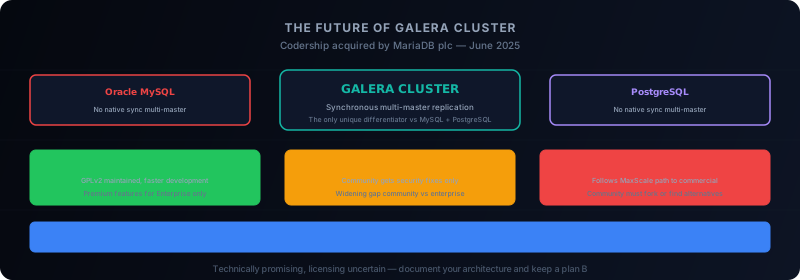
From a competitive standpoint, Galera is MariaDB's trump card against two giants:
Against Oracle MySQL
MySQL does not offer native synchronous multi-master replication. MySQL Group Replication and MySQL InnoDB Cluster are Oracle's answers, but they do not match Galera's maturity and adoption. By acquiring Codership, MariaDB ensures this technological lead remains exclusive.
Against PostgreSQL
PostgreSQL also lacks native synchronous multi-master replication. Third-party solutions exist (EDB's BDR, Citus for sharding), but none is as integrated as Galera is with MariaDB.
Galera is literally the only technical argument that makes MariaDB unique compared to these two competitors. Without Galera, MariaDB is "just a MySQL fork." With Galera, it is a clustering ecosystem without equal.
Impact on Percona
The most concrete impact is on Percona. Percona XtraDB Cluster (PXC) uses the Galera library under GPLv2. As long as the license does not change, PXC can continue to exist.
But if new Galera versions are reserved for MariaDB Enterprise:
- PXC will be stuck on the last GPLv2 version of Galera
- Bugs and security vulnerabilities discovered in new versions will not be fixed in the community version
- Percona will either have to fork Galera (costly), find an alternative (difficult), or negotiate a commercial agreement with MariaDB plc
Impact on the Community
For the MariaDB community, the acquisition is double-edged:
The positive: Faster Galera development, better integration with the MariaDB server, potentially new features (geographic replication, better conflict handling, improved performance).
The negative: Increased dependence on a single commercial company for a critical component. If MariaDB plc decides to restrict access, the community has no immediate alternative.
The lesson: Governance matters. The MariaDB Foundation manages the community server. Galera, on the other hand, is in the hands of MariaDB plc (via Codership). There is no independent foundation to protect Galera.
Scenarios for the Future
Optimistic Scenario
MariaDB plc maintains Galera GPLv2 for the community, adds premium features to the Enterprise edition, and everyone benefits. Development accelerates, Galera gets even better.
Realistic Scenario
The community version of Galera receives security fixes but not new features. The gap widens between community and enterprise. Serious users migrate to the paid edition.
Pessimistic Scenario
Galera follows MaxScale's path. The community version is frozen, new versions are commercial only. The community must fork or seek alternatives.
My Take
The Codership acquisition is logical for MariaDB plc. Galera is too strategic to leave in the hands of an independent company. Control allows aligning the Galera roadmap with that of MariaDB Enterprise.
But the community must remain vigilant. MaxScale's history shows that promises to maintain open-source have a limited lifespan when financial pressures intensify.
My advice: take advantage of community Galera while it is here. Document your architecture. And keep a plan B — whether it is semi-synchronous replication with ProxySQL, Percona XtraDB Cluster, or even PostgreSQL with Patroni.
The future of Galera Cluster has never been more promising technically. It has never been more uncertain from a licensing perspective.
This article was originally published on Medium.
Comments (0)
No comments yet.
Leave a comment