 PmaControl
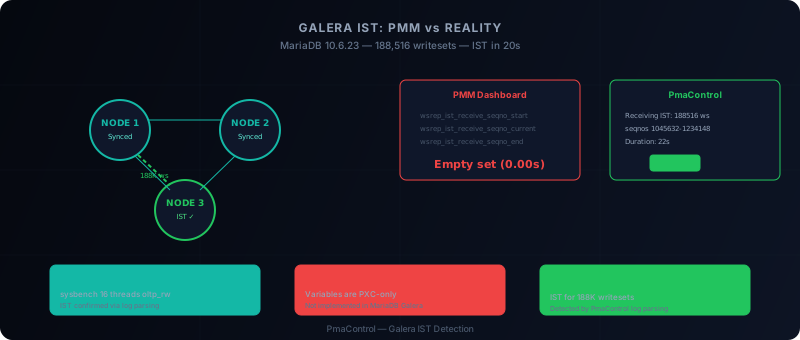
The PMM Dashboard Myth for Galera IST
If you use Percona Monitoring and Management (PMM) to monitor a Galera cluster on MariaDB, you have probably noticed a panel titled "IST Progress" or "IST Receive". It shows... nothing. Empty rows, N/A values, flat graphs.
This is not a display bug. The variables PMM queries simply do not exist on MariaDB 10.6.
Refresher: IST vs SST
When a Galera node rejoins the cluster after a disconnection, two synchronization mechanisms are available:
- SST (State Snapshot Transfer): the donor node sends a full copy of the dataset. Slow, expensive, potentially blocks the donor. We are talking minutes to hours depending on volume.
- IST (Incremental State Transfer): the donor sends only the missing writesets from the GCache. Fast, lightweight, a few seconds to a few minutes.
The difference is critical in production. A 20-second IST is invisible to users. A 45-minute SST can cause an outage.
The Test: MariaDB 10.6.23 + sysbench
To document the real behavior, we set up a 3-node Galera cluster on MariaDB 10.6.23 and ran a continuous sysbench workload:
sysbench oltp_read_write --tables=10 --table-size=100000 \
  --threads=16 --time=600 --db-driver=mysql run
During the workload, we stopped node 3 for 30 seconds, then restarted it. Result:
- 188,516 writesets accumulated in the donor's GCache
- Node 3 rejoined the cluster via IST in 20-25 seconds
- No service interruption on nodes 1 and 2
The MariaDB log on node 3 confirms:
[Note] WSREP: Receiving IST: 188516 writesets, seqnos 1045632-1234148
[Note] WSREP: IST received: 85a4c3e2-xxxx
[Note] WSREP: 3.0 (node3): State transfer from 0.0 (node1) complete.
IST worked perfectly. Now let us see what PMM says about it.
What PMM Tries to Read
The PMM v2 Galera dashboard queries the following variables to chart IST progress:
SHOW GLOBAL STATUS LIKE 'wsrep_ist_receive_seqno_start';
SHOW GLOBAL STATUS LIKE 'wsrep_ist_receive_seqno_current';
SHOW GLOBAL STATUS LIKE 'wsrep_ist_receive_seqno_end';
On MariaDB 10.6.23, all three queries return an empty result set. The variables do not exist.
MariaDB [(none)]> SHOW GLOBAL STATUS LIKE 'wsrep_ist%';
Empty set (0.001 sec)
This is not a configuration oversight. These variables are specific to Percona XtraDB Cluster (PXC) and have never been implemented in the MariaDB Galera provider.
The SST Wrapper Trap
An additional detail creates confusion: even during an IST, MariaDB invokes the SST wrapper script (wsrep_sst_mariabackup or wsrep_sst_rsync). The log therefore contains lines like:
WSREP: Running: 'wsrep_sst_mariabackup --role donor ...'An operator reading these logs might conclude that a full SST is in progress. In reality, the wrapper initializes and then detects that the catch-up will happen via IST. The actual transfer is incremental.
How to Detect an IST on MariaDB
Since the PMM variables do not exist, an alternative approach is needed. Three methods:
1. Parse the MariaDB Log
The IST signature in the log is unambiguous:
[Note] WSREP: Receiving IST: <N> writesets, seqnos <start>-<end>A simple grep on the error log gives the answer instantly. This is the most reliable method.
2. Observe wsrep_local_state_comment
During an IST, the wsrep_local_state_comment variable on the rejoining node transitions through:
Joining → Joined → SyncedIf this transition takes less than 30 seconds on an active cluster, it is very likely an IST. An SST on a dataset of several tens of gigabytes would take much longer.
3. Check the GCache
The wsrep_local_cached_downto variable on the donor indicates the oldest seqno still available in the GCache. If the disconnected node's seqno is higher than this value, IST is possible:
-- On the donor
SHOW GLOBAL STATUS LIKE 'wsrep_local_cached_downto';
-- Result: 1045000

-- If the disconnected node was at seqno 1045632 → IST possible
-- If the disconnected node was at seqno 800000 → SST required
What PmaControl Does
PmaControl combines all three methods to automatically detect and classify Galera transfers:
- Continuous monitoring of
wsrep_local_state_comment— detects the transition toJoiningstate - MariaDB log parsing — extracts the
Receiving ISTline with the writeset count - Temporal correlation — measures the time between
JoiningandSynced
The result is displayed in the PmaControl dashboard with a clear distinction: IST (green badge, duration in seconds) vs SST (orange badge, estimated duration in minutes).
Unlike PMM, PmaControl does not depend on variables that only exist on PXC. The log parsing approach works on all versions of MariaDB Galera since 10.1.
Key Numbers
| Metric | Observed Value |
|---|---|
| Tested version | MariaDB 10.6.23 Galera |
| sysbench workload | 16 threads, oltp_read_write |
| Accumulated writesets | 188,516 |
| IST duration | 20-25 seconds |
| PMM wsrepist* variables | Do not exist |
| PmaControl detection | Automatic via log parsing |
Recommendations
- Do not rely on the PMM Galera dashboard for IST tracking if you run MariaDB — the panels will remain empty
- Size the GCache generously (
gcache.size=2Gminimum) to maximize IST chances after a brief disconnection - Centralize MariaDB logs — they are the source of truth for Galera transfers
- Use PmaControl for Galera monitoring that actually works on MariaDB, not only on PXC
Conclusion
The PMM dashboard for Galera IST is designed for Percona XtraDB Cluster. On MariaDB Galera, it shows nothing — not because IST does not work, but because the variables it queries do not exist.
IST works perfectly on MariaDB 10.6. You just need to know where to look: in the logs, not in phantom variables.
Comments (0)
No comments yet.
Leave a comment