 PmaControl
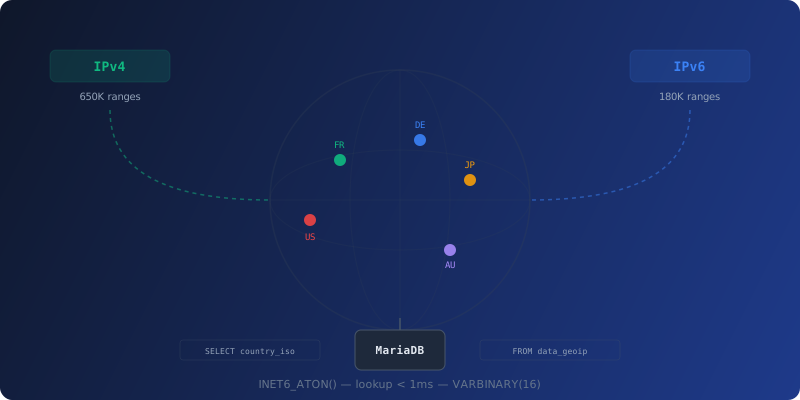
The Problem
When you monitor 100+ MariaDB/MySQL servers spread across multiple datacenters and countries, one question comes up every time the main page loads: where is this server?
The classic answer: open the MaxMind GeoLite2 .mmdb file, perform a lookup for each IP, and display the country flag. Simple... except that:
- Opening a 70 MB
.mmdbfile on every HTTP request is expensive - With 100 servers to resolve, that's 100 file lookups per page
- The file is a binary tree optimized for sequential reads, not for parallel bursts
- In PHP-FPM, each worker reloads the file independently
In PmaControl, the server/main page refreshes every second via AJAX. Opening the .mmdb 100 times per second is nonsensical.
The Solution: Put Everything in MariaDB
The idea is simple: import all GeoLite2 ranges into a MariaDB table, then perform standard SQL lookups. A SELECT with an index is much faster than traversing a binary tree on disk.
The Schema
CREATE TABLE data_geoip (
  id INT AUTO_INCREMENT PRIMARY KEY,
  network_start VARBINARY(16) NOT NULL,
  network_end   VARBINARY(16) NOT NULL,
  country_iso   CHAR(2) NOT NULL DEFAULT '',
  country_name  VARCHAR(100) NOT NULL DEFAULT '',
  INDEX idx_network_start (network_start)
) ENGINE=InnoDB;
The choice of VARBINARY(16) is crucial:
- 4 bytes are enough for IPv4 (32 bits)
- 16 bytes are needed for IPv6 (128 bits)
VARBINARY(16)stores both uniformlyINET6_ATON()converts any IP (v4 or v6) to comparable binary
The Lookup Query
SELECT country_iso FROM data_geoip
WHERE network_start <= INET6_ATON('89.30.104.134')
  AND network_end   >= INET6_ATON('89.30.104.134')
LIMIT 1;
Result: FR (France). Execution time: < 1 ms.
The same query works for IPv6:
SELECT country_iso FROM data_geoip
WHERE network_start <= INET6_ATON('2001:4860:4860::8888')
  AND network_end   >= INET6_ATON('2001:4860:4860::8888')
LIMIT 1;
Result: US (United States — that's Google's public DNS).
The Import: Iterating Over IP Space
IPv4: From 0.0.0.0 to 255.255.255.255
The IPv4 space spans 2^32 = 4.3 billion addresses. We don't iterate one by one — we use getWithPrefixLen() from the MaxMind reader, which returns the full CIDR for each address:
$ip = 0;
while ($ip <= 4294967295) {
    [$record, $prefixLen] = $reader->getWithPrefixLen(long2ip($ip));

    // Calculate network end
    $networkSize = 1 << (32 - $prefixLen);
    $networkEnd = $ip + $networkSize - 1;

    if ($record && !empty($record['country']['iso_code'])) {
        // INSERT into data_geoip
    }

    // Skip the entire CIDR block
    $ip = $networkEnd + 1;
}
The result: ~650,000 ranges imported in a few seconds. Each range covers an entire CIDR block (e.g., 89.30.104.0/22 → 1,024 addresses in a single row).
IPv6: The 2000::/3 Space
The IPv6 space spans 2^128 addresses — impossible to iterate like IPv4. But routable public addresses live in the 2000::/3 block (Global Unicast), and GeoIP allocations are typically /32 to /48.
The principle is the same: advance by the size of the returned prefix. The difference: we work with 16-byte binary addresses.
$current = inet_pton('2000::');
$end6    = inet_pton('3fff:ffff:ffff:ffff:ffff:ffff:ffff:ffff');

while ($current <= $end6) {
    [$record, $prefixLen] = $reader->getWithPrefixLen(inet_ntop($current));
    $endBin = binNetworkEnd($current, $prefixLen);

    if ($record && !empty($record['country']['iso_code'])) {
        // INSERT with UNHEX(bin2hex(...))
    }

    $current = binIncrement($endBin); // +1 in 128-bit arithmetic
}
The 128-bit binary arithmetic is implemented in pure PHP (no GMP required):
// Increment an IPv6 address by 1
function binIncrement(string $bin): string|false
{
    $bytes = unpack('C16', $bin);
    for ($i = 15; $i >= 0; $i--) {
        $bytes[$i]++;
        if ($bytes[$i] <= 255) return pack('C16', ...$bytes);
        $bytes[$i] = 0; // carry
    }
    return false; // overflow
}
Results in Production
Volumes
| Table | IPv4 | IPv6 | Total |
|---|---|---|---|
data_geoip (country) |
~650K | ~180K | ~830K ranges |
data_geoip_city (city) |
~3.7M | ~1.2M | ~4.9M ranges |
Performance
| Operation | Time |
|---|---|
| Country import (IPv4 + IPv6) | ~30 seconds |
| City import (IPv4 + IPv6) | ~5 minutes |
| 1 IP lookup | < 1 ms |
| 100 IP lookups (server/main page) | ~15 ms total |
| AJAX refresh (1x/second) | negligible |
Display
On PmaControl's main page, each server displays its emoji flag next to the IP:
🇫🇷 89.30.104.134:3306    PIXID-MDB-MASTER1
🇩🇪 136.243.1.1:3306       Hetzner-Slave
🇯🇵 210.171.224.1:3306     NTT-Tokyo
🇺🇸 8.8.8.8:3306           Google-Test
Private IPs (10.x, 172.16-31.x, 192.168.x, 127.x) have no GeoLite2 record — the flag is simply absent.
Updates
MaxMind updates GeoLite2 every week. To refresh:
# Download the new .mmdb into data/
# Then re-run the import:
php App/Webroot/index.php server loadGeoip       # country (~30s)
php App/Webroot/index.php server loadGeoipCity   # city (~5min)
The import does a TRUNCATE then reinserts everything. No diff or migration needed — it's a disposable cache.
City Table: Going Further
The data_geoip_city table adds region, city, GPS coordinates, and timezone:
SELECT country_iso, region_name, city, latitude, longitude, time_zone
FROM data_geoip_city
WHERE network_start <= INET6_ATON('136.243.1.1')
  AND network_end   >= INET6_ATON('136.243.1.1')
LIMIT 1;
Result: DE | Saxony | Falkenstein | 50.4779 | 12.3713 | Europe/Berlin
This opens the door to server cartography, inter-datacenter latency detection, or simply a richer display in the interface.
Why Not Just a LEFT JOIN?
You might want to do a LEFT JOIN data_geoip g ON g.network_start <= INET6_ATON(s.ip) AND g.network_end >= INET6_ATON(s.ip) directly in the server query. The problem: with 650K ranges, this range-join is expensive for the optimizer. We prefer N individual lookups (1 per unique IP) which are instant thanks to the index.
Conclusion
By importing GeoLite2 data into MariaDB, we eliminate the dependency on the .mmdb file for every page render. The lookup becomes an indexed SELECT at < 1 ms, compatible with both IPv4 and IPv6, and the update process is a simple weekly TRUNCATE + INSERT.
The source code is available on GitHub — contributions welcome.
Comments (0)
No comments yet.
Leave a comment