 PmaControl
The Context: PmaControl's Hottest Write Path
Every few seconds, each PmaControl agent collects hundreds of metrics from your MariaDB / MySQL servers: status variables, InnoDB counters, replication state, query digests. All of it converges on Integrate::insert_value(), which writes those measurements into the ts_value_general_* tables — the busiest write path in the application.
To stay safely below max_allowed_packet, tuples are grouped into chunks: the SQL budget is computed dynamically from the server (with a safety margin), and a batch of 200,000 measurements becomes, say, 32 INSERT INTO ... VALUES (...), (...), ... statements of roughly 256 KiB each.
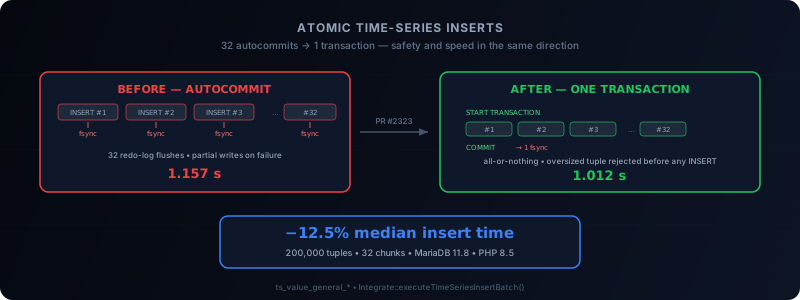
Until now, those 32 statements ran in autocommit mode: 32 INSERTs, 32 implicit COMMITs.
The Bug: Silent Partial Writes
What happens if chunk 17 fails — table full, deadlock, lost connection?
Before the fix: chunks 1 through 16 stayed written, chunks 17 through 32 were lost, and the downstream bookkeeping (server/variable linking, ingestion checkpoint) could run as if everything had succeeded. A logical batch turned into a silent partial write — the worst possible scenario for monitoring data: charts with holes that nothing ever reports.
Three distinct issues converged on this same root cause:
- #1467 / #1471 — partial writes when a failure hits mid-batch;
- #1468 / #1472 — a single tuple larger than the budget was still sent to the server, guaranteed to fail on
max_allowed_packet; - #1469 — a silent fallback could disable dynamic budget detection.
The Fix: One Batch = One Transaction
The fix (PR #2323) introduces executeTimeSeriesInsertBatch(): all chunks of a given metric type are now wrapped in a single transaction:
START TRANSACTION;
INSERT INTO ts_value_general_int (...) VALUES (...), (...), ...;  -- chunk 1
INSERT INTO ts_value_general_int (...) VALUES (...), (...), ...;  -- chunk 2
-- ... 30 more chunks ...
COMMIT;
Any failure — falsy result, non-benign warning, exception — triggers a ROLLBACK and raises a typed exception carrying safe diagnostic metadata (table, chunk, estimated bytes, budget). The measurement file is kept for replay: either the whole batch is persisted, or none of it is.
As a bonus, an isolated tuple whose estimated size already exceeds the budget is detected before the transaction even opens: no INSERT that is doomed to fail is ever sent to the server.
The 12% Question: What Does It Cost?
A transaction spanning 32 statements means extra accounting on the InnoDB side: a longer undo log, locks held longer. We expected to pay a small overhead, which we considered well worth the atomicity guarantee.
We benchmarked before merging. Protocol:
- an exact replay of the
insert_value()hot loop (chunking → SQL build → execution), not a synthetic micro-benchmark; - 200,000 deterministic tuples into
ts_value_general_int(unique primary keys), 256 KiB budget → 32 chunks; - MariaDB 11.8, PHP 8.5.8, InnoDB table,
TRUNCATEbetween runs, 1 warmup + 5 measured runs; - same LXC container, same data, only the application code changes between the two measurements.
Results:
| Run | Before (autocommit ×32) | After (1 transaction) |
|---|---|---|
| 1 | 1.127 s | 0.927 s |
| 2 | 1.199 s | 0.947 s |
| 3 | 1.155 s | 1.012 s |
| 4 | 1.168 s | 1.019 s |
| 5 | 1.157 s | 1.026 s |
| Median | 1.157 s | 1.012 s |
12.5% faster on the median. The atomicity fix costs nothing: it saves time. Ingestion throughput goes from roughly 173,000 to 198,000 measurements per second.
Why It's Faster: The Hidden Price of COMMIT
The answer lies in what a COMMIT actually does under InnoDB.
On every commit, InnoDB must make the transaction durable: write the redo log pages and — with innodb_flush_log_at_trx_commit = 1, the default and the only truly safe value — force an fsync() of the log file. That flush is the most expensive operation in a transaction's life cycle: it physically waits for storage.
In autocommit mode, every INSERT is its own transaction:
- before: 32 chunks = 32 COMMITs = 32 redo log flushes;
- after: 32 chunks = 1 COMMIT = 1 redo log flush.
The 31 saved synchronizations outweigh the slightly longer undo log by a wide margin. It's the same mechanism that makes a SQL import dramatically faster when wrapped in a transaction, or that lets MariaDB's group commit amortize flushes across concurrent transactions — applied here inside a single logical batch.
Note that the gain depends on hardware: on storage where fsync() is very slow (spinning disks, virtualization without a safe write cache), the gap widens further. On fast NVMe it narrows. But the sign never flips: the single transaction is always at least as fast.
Takeaways
- Atomicity is not a luxury you pay for; it's often an optimization. Grouping related writes into one transaction eliminates redo log flushes — safety and performance point in the same direction.
- Benchmark the real code path. Replaying the actual hot loop against a real database is what turned "we accept the overhead" into "there is no overhead."
- Failure must be loud and total. A half-written metrics batch is worse than a replayed one: since this fix, PmaControl guarantees all-or-nothing time-series ingestion.
This fix has been available on PmaControl's master branch since July 25, 2026.
Comments (0)
No comments yet.
Leave a comment