 PmaControl
The Proustian Concept
In "Swann's Way," Marcel Proust describes a foundational moment of French literature: by dipping a madeleine into a cup of tea, the narrator is overwhelmed by a flood of childhood memories he thought forgotten. The smell, the taste, the texture — these sensations triggered what Proust calls "involuntary memory."
Involuntary memory is not conscious recall, the kind we summon deliberately. It is the memory that invades us without warning, triggered by a sensation — a smell, a sound, a taste — and that brings us back, for a moment, to a past experience with a vividness that conscious memory cannot achieve.
Everyone has their madeleine de Proust. Here is mine.
Sick Day Mornings
When I was a child, sick days had a particular ritual. Not the serious illnesses — the small colds, sore throats, mild fevers that kept you home but did not confine you to bed.
On those days, my grandparents took over. While my parents worked, they watched over the little patient. And in the morning, without exception, my grandfather took me to the bakery.
The Walk to the Bakery
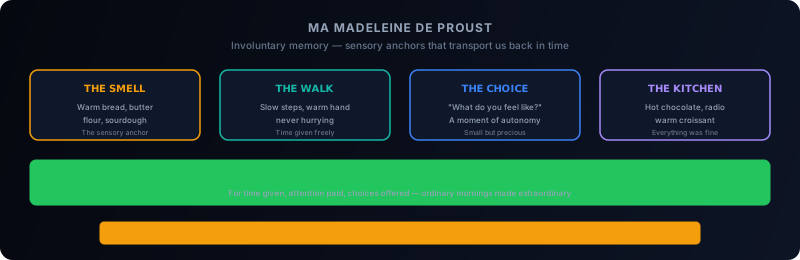
I remember the walk. Not the details — the streets, the houses, the distances are blurry. But I remember my grandfather's hand. Large, calloused, warm. A hand that had worked all its life and held mine with a gentleness that contrasted with its roughness.
I remember the rhythm of his steps. Slow, regular, adapted to my small legs. He never hurried. The walk to the bakery was not a race — it was a stroll, even when it was cold, even when my nose was running.
The Smell
And then there was the smell. The bakery smell.
That is my madeleine de Proust. That smell of warm bread, butter, flour, and sourdough that envelops you when you push the door open. A smell without equivalent, that cannot be reproduced by a diffuser or room fragrance. It is the smell of baking, of time, of craftsmanship.
Even today, when I pass an artisan bakery and catch that smell, I am transported. For a fraction of a second, I am no longer a hurried adult walking down a street. I am a six-year-old child, hand in his grandfather's, nose a bit red, waiting for a croissant.
The Choice
The moment of choice at the display case was sacred. My grandfather never said "have a croissant" or "have a pain au chocolat." He said: "What do you feel like?" And he waited, patiently, for me to scan the display with my eyes, to hesitate between the chocolate religieuse and the apple turnover, to change my mind three times before finally pointing at my selection.
It was not the choice that mattered. It was that he gave me the choice. In a world where children are told what to do from morning to night, that small moment of autonomy was precious.
The Walk Back
The walk back was different. I had my treasure: a warm paper bag containing my pastry. I walked a bit faster, eager to settle at my grandparents' kitchen table, pour a bit too much cocoa powder into my bowl of warm milk, and bite into that still-warm croissant.
My grandmother was there, in the kitchen. Coffee was already ready. The radio played the morning news softly. And for a moment, the world was exactly the right size: a warm kitchen, a croissant, two grandparents, and the absolute certainty that everything was fine.
Sensory Anchors
Cognitive psychology speaks of "sensory anchors" — stimuli that trigger strong emotional responses because they are associated with significant experiences. The bakery smell is my anchor.
What Proust understood before neuroscientists is that these anchors are not memories. They are portals. They do not show us the past — they bring us back to it, with an emotional intensity that conscious recall cannot reproduce.
Gratitude
What I take from this madeleine de Proust, beyond nostalgia, is gratitude.
Gratitude for a grandfather who took the time. Who walked slowly. Who offered choices. Who never said "hurry up." Who turned a sick morning into a small happiness.
Gratitude for a grandmother who had the coffee ready, the hot chocolate bowl prepared, and that ability to make an ordinary kitchen extraordinarily welcoming.
Gratitude for those simple moments that, decades later, remain the most vivid and precious memories. Not the spectacular vacations, not the expensive gifts, not the memorable events. Ordinary mornings transformed into extraordinary moments by the simple loving presence of two people.
What Madeleines Teach Us
We build complex systems. We optimize SQL queries, configure Galera clusters, deploy distributed architectures. That is our profession, and it has value.
But the moments that truly matter — those etched into our sensory memory, those that surge up decades later outside a bakery — those moments are simple. They are made of time given, attention paid, choices offered.
Next time you pass a bakery and the smell transports you somewhere, stop for a moment. Savor the journey. And if you have a child or grandchild at home, take them by the hand and go get a croissant together.
Some memories are worth more than all the systems we will ever build.
This article was originally published on Medium.
Comments (0)
No comments yet.
Leave a comment