 PmaControl
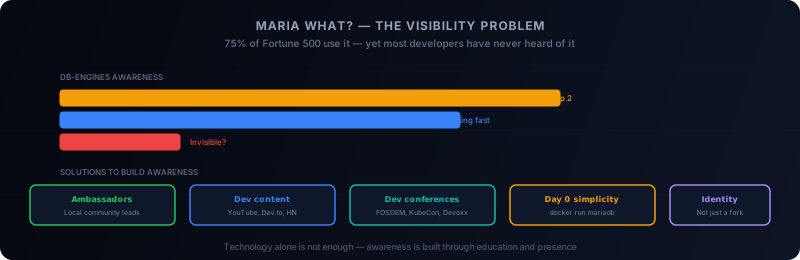
The Hallway Test
Try this experiment. Next time you are at a tech meetup, a developer conference, or simply at the office, ask the question: "Do you know MariaDB?"
In a group of DBAs, the answer is unanimous. Everyone knows it, many use it. But in a group of fullstack developers, DevOps engineers, or startup CTOs? The answer is too often: "Maria what?"
This is the MariaDB paradox: used by 75% of Fortune 500 companies, the default engine in most Linux distributions, yet largely unknown to the general tech public.
The Uncomfortable Numbers
Let us look at DB-Engines rankings, the industry reference:
- Oracle MySQL: solidly installed in the top 2, with overwhelming awareness
- PostgreSQL: continuously growing for 10 years, now the "cool" developer choice
- MariaDB: stable but far behind, often confused with MySQL
Google Trends tells the same story. Searches for "MariaDB" represent a fraction of those for "MySQL" or "PostgreSQL." In job listings, "MySQL" appears 10 times more often than "MariaDB," even when the position actually involves MariaDB.
The problem is not technical. MariaDB is an excellent RDBMS, with unique features (Galera, ColumnStore, multiple storage engines). The problem is marketing.
Misaligned Marketing
MariaDB plc's marketing in recent years has focused on direct competition with Oracle and AWS. The messaging centers on "enterprise-grade," "cloud-native," "AI-powered." This is classic B2B targeting CIOs and procurement managers.
The problem is that technology decisions are no longer made solely at the executive level. They are also made (primarily?) by developers and architects. And these people are not exposed to MariaDB's B2B marketing.
Compare with PostgreSQL. The PostgreSQL community produces a constant stream of:
- Technical blog posts on concrete use cases
- Talks at developer conferences (not just DBA conferences)
- Video tutorials accessible to beginners
- Open-source extensions and tools that generate buzz
MariaDB does some of these things, but not at the same scale, and not with the same "developer-first" orientation.
The Identity Problem
MariaDB suffers from a fundamental identity problem: is it "MySQL but better" or is it a distinct product?
The name "MariaDB" itself is a problem. For the uninitiated, it communicates nothing. "Postgre" evokes "PostgreSQL," "Mongo" evokes "MongoDB." "Maria" evokes... nothing technological.
Moreover, confusion with MySQL is permanent. Many people use MariaDB without knowing it (via Linux distributions that include it by default). Connectors are often called "mysql-connector," commands are mysql and mysqldump. The visual and linguistic identity is completely tied to MySQL.
This is an advantage for compatibility but a disaster for brand awareness.
What MariaDB Should Do
1. Create an Ambassador Program
PostgreSQL has its "community contributors" who evangelize the technology at local events. MariaDB should do the same: identify enthusiasts in each region, financially support them to organize meetups, and provide them with marketing content.
2. Invest in Educational Content
Not 40-page whitepapers for CIOs. Practical 10-minute tutorials for developers. "How to start with MariaDB in 5 minutes," "MariaDB vs MySQL: the 10 differences that matter," "Galera for beginners."
The content must be where developers look for it: YouTube, Dev.to, Hacker News, Reddit r/programming. Not solely on MariaDB's official blog.
3. Be Present at Developer Conferences
KubeCon, FOSDEM, Devoxx, DotJS, VoxxedDays — not just database conferences. A convinced DBA who chooses MariaDB is good. A convinced developer who proposes MariaDB for their next project is better.
4. Simplify Onboarding
The MariaDB "Day 0" experience should be as simple as docker run mariadb. And the documentation should guide a beginner from installation to a working application in 30 minutes, with examples in popular languages (Python, Node.js, Go, Java).
5. Communicate on Differences
Stop positioning as "MySQL compatible" and start communicating on what is unique: Galera, multiple storage engines, sequence support, recursive CTEs (well before MySQL), ColumnStore, Foundation governance...
The Role of the Community
The MariaDB Foundation does excellent technical work with a small team. But awareness is not built solely with code. It is built with stories, use cases, and testimonials.
Every MariaDB user who writes a blog post, who gives a talk, who answers a question on Stack Overflow, contributes to visibility. It is a collective effort.
If you use MariaDB in production and it is going well: say so. Write an article. Share your experience. The best advertising for open-source software is user satisfaction.
Conclusion
"Maria what?" should no longer be a question. MariaDB is a mature, high-performance RDBMS with a solid community and healthy governance. But technology alone is not enough. Awareness is built through education, presence, and communication.
It is time for MariaDB to step out of MySQL's shadow and build its own identity. Not as a "MySQL fork," but as the database of choice for architects who want performance, flexibility, and openness.
This article was originally published on Medium.
Comments (0)
No comments yet.
Leave a comment