 PmaControl
The Fork That Changed History
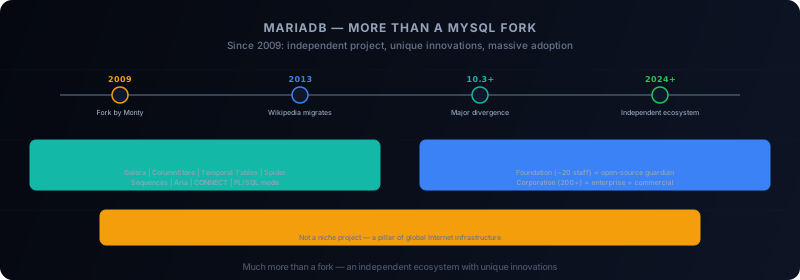
In 2009, when Oracle acquired Sun Microsystems (and with Sun, MySQL), Monty Widenius — the original creator of MySQL — made a decision that changed the database ecosystem: he forked MySQL to create MariaDB.
At the time, many saw MariaDB as a simple insurance policy against Oracle's proprietary tendencies. A "MySQL backup" in case Oracle decided to close the code. Sixteen years later, MariaDB has become much more than that.
Technical Divergence
MariaDB and MySQL began to diverge significantly after MySQL 5.7 / MariaDB 10.3. The two projects took different technical paths:
What MariaDB has that MySQL does not:
- Integrated Galera Cluster for synchronous multi-master replication
- Multiple storage engines (Aria, ColumnStore, Spider, CONNECT, RocksDB via MyRocks)
- Standard SQL sequences (CREATE SEQUENCE)
- System-versioned temporal tables
- The Aria engine (crash-safe MyISAM replacement)
- Window functions and CTEs (implemented before MySQL)
- Oracle PL/SQL compatibility mode
What MySQL has that MariaDB does not:
- MySQL HeatWave (in-memory analytical acceleration)
- Clone plugin (fast replica provisioning)
- Native Group Replication / InnoDB Cluster
- MySQL Shell (advanced CLI with JavaScript/Python)
- Hash join (implemented before MariaDB)
Both projects continue evolving independently. Compatibility is gradually decreasing: migrating from MySQL to MariaDB (or vice versa) is less and less trivial with each version.
Dual Governance
One of MariaDB's strengths is its unique governance model:
The MariaDB Foundation
A non-profit organization, the Foundation employs about 20 people and focuses on developing and maintaining the community server. It ensures MariaDB remains open-source and accessible to all.
MariaDB plc (the Corporation)
A commercial company with over 200 employees, MariaDB plc develops Enterprise products (MariaDB Enterprise Server, MaxScale, SkySQL). It funds much of the community server development but also controls proprietary components.
This dual model creates productive tension: the Foundation pushes for openness, the Corporation pushes for monetization. The result is a (sometimes fragile) balance between open-source and business.
Adoption
The numbers speak for themselves:
- 75% of Fortune 500 companies use MariaDB
- Default distribution in Debian, Ubuntu, Red Hat, SUSE, Arch Linux
- Wikipedia migrated from MySQL to MariaDB in 2013
- DBS Bank (largest Southeast Asian bank) uses MariaDB for core systems
- WordPress.com (Automattic) uses MariaDB
- Google uses MariaDB internally for certain services
MariaDB is not a niche project. It is a pillar of global Internet infrastructure.
Continuous Innovation
What distinguishes MariaDB from other forks that failed is continuous innovation:
ColumnStore: a columnar storage engine for analytics, combining OLTP (InnoDB) and OLAP (ColumnStore) in the same server.
Temporal Tables: system-versioned tables allow querying the database state at any past moment. SELECT * FROM orders FOR SYSTEM_TIME AS OF '2024-01-01' — without any application modification.
Spider: a storage engine enabling transparent sharding across multiple servers.
CONNECT: an engine accessing external data (CSV, JSON, XML, remote databases, web services) as native SQL tables.
Why "Fork" Is Reductive
Calling MariaDB a "MySQL fork" in 2024 is like calling Chrome a "Safari fork" (both descend from WebKit/KHTML). Technically true but fundamentally misleading.
MariaDB is an independent project with its own technical roadmap, governance, innovations, community, and commercial ecosystem.
Conclusion
MariaDB was born as a MySQL fork. It grew as an independent project. It has become a complete database ecosystem with unique innovations and massive adoption.
"Much more than just a fork" is not a marketing slogan. It is a technical fact, documented in every release note, every storage engine, every feature that MySQL does not have.
This article was originally published on Medium.
Comments (0)
No comments yet.
Leave a comment