 PmaControl
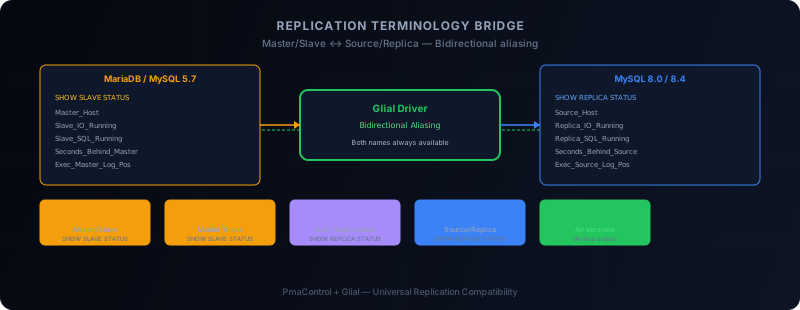
The Rename
MySQL 8.0.22 introduced a major terminology change: the terms Master and Slave in replication commands and output columns were replaced by Source and Replica.
This is not just a cosmetic change. Concretely:
SHOW SLAVE STATUSbecomesSHOW REPLICA STATUSCHANGE MASTER TObecomesCHANGE REPLICATION SOURCE TO- The
Master_Hostcolumn in the output becomesSource_Host Slave_IO_RunningbecomesReplica_IO_RunningSlave_SQL_RunningbecomesReplica_SQL_RunningSeconds_Behind_MasterbecomesSeconds_Behind_Source
And so on for about thirty columns.
MySQL 8.0 maintains backward compatibility: the old commands still work (with a deprecation warning). But MySQL 8.4 starts removing old aliases. And MariaDB, on its side, keeps the historical terminology.
The Problem for Monitoring Tools
Any tool that parses the output of SHOW SLAVE STATUS / SHOW REPLICA STATUS must now handle two sets of column names depending on the server version:
| Old (MariaDB, MySQL 5.7) | New (MySQL 8.0+) |
|---|---|
| Master_Host | Source_Host |
| Master_User | Source_User |
| Master_Port | Source_Port |
| Master_Log_File | Source_Log_File |
| Read_Master_Log_Pos | Read_Source_Log_Pos |
| Slave_IO_Running | Replica_IO_Running |
| Slave_SQL_Running | Replica_SQL_Running |
| Slave_IO_State | Replica_IO_State |
| Seconds_Behind_Master | Seconds_Behind_Source |
| Last_IO_Error | Last_IO_Error |
| Last_SQL_Error | Last_SQL_Error |
| Exec_Master_Log_Pos | Exec_Source_Log_Pos |
The problem is twofold:
- Existing code uses the old column names everywhere. Hundreds of references to
$row['Master_Host']or$row['Slave_IO_Running']. - The infrastructure is mixed: MariaDB 10.6 and 10.11, MySQL 5.7 at end-of-life, MySQL 8.0, freshly deployed MySQL 8.4. All in the same PmaControl.
The Naive Solution (and Why It Fails)
The first idea: detect the version and use the right column name.
// Don't do this
if ($version >= '8.0.22') {
    $host = $row['Source_Host'];
    $io_running = $row['Replica_IO_Running'];
} else {
    $host = $row['Master_Host'];
    $io_running = $row['Slave_IO_Running'];
}
This pattern is catastrophic to maintain. Every place in the code that reads a replication field must be duplicated. With 30 columns and dozens of code locations, you end up with hundreds of conditions.
And when MySQL 9.0 adds new aliases? Triple the code?
The Glial Approach: Bidirectional Aliasing at the Driver Level
The solution implemented in the Glial framework (which provides PmaControl's MySQL access layer) is more elegant: bidirectional aliasing at the driver level.
When the Glial driver executes SHOW REPLICA STATUS (or SHOW SLAVE STATUS), it enriches the result by adding both names for each column:
// In Glial's MySQL driver
$replication_aliases = [
    'Master_Host'          => 'Source_Host',
    'Master_User'          => 'Source_User',
    'Master_Port'          => 'Source_Port',
    'Master_Log_File'      => 'Source_Log_File',
    'Read_Master_Log_Pos'  => 'Read_Source_Log_Pos',
    'Slave_IO_Running'     => 'Replica_IO_Running',
    'Slave_SQL_Running'    => 'Replica_SQL_Running',
    'Slave_IO_State'       => 'Replica_IO_State',
    'Seconds_Behind_Master'=> 'Seconds_Behind_Source',
    'Exec_Master_Log_Pos'  => 'Exec_Source_Log_Pos',
    // ... all pairs
];

// After fetching the result
foreach ($replication_aliases as $old => $new) {
    if (isset($row[$old]) && !isset($row[$new])) {
        $row[$new] = $row[$old];
    }
    if (isset($row[$new]) && !isset($row[$old])) {
        $row[$old] = $row[$new];
    }
}
The result: consuming code can use either the old or the new name interchangeably. Whether the server is MariaDB 10.6, MySQL 5.7, MySQL 8.0 or MySQL 8.4, both names always exist in the result.
The Advantages of This Approach
1. Zero Changes to Existing Code
The hundreds of references to $row['Master_Host'] in PmaControl continue to work. No code migration required.
2. New Code Can Use the New Terminology
Developers writing new code can use $row['Source_Host'] right now. When old code is gradually refactored, the transition will be transparent.
3. Single Maintenance Point
The aliasing is defined once, in the driver. If MySQL 9.0 adds new fields or renames other columns, you only need to extend the aliases array.
4. Compatibility with Both SHOW Commands
The driver first attempts SHOW REPLICA STATUS. If the command fails (MySQL 5.7, MariaDB), it falls back to SHOW SLAVE STATUS. In both cases, the result contains both sets of names.
try {
    $result = $db->query('SHOW REPLICA STATUS');
} catch (Exception $e) {
    $result = $db->query('SHOW SLAVE STATUS');
}
// In all cases, $result contains Master_Host AND Source_Host
The Multi-Source Case
MySQL 8.0 supports multi-source replication (multiple channels). The SHOW REPLICA STATUS command then returns multiple rows, one per channel. The aliasing applies to each row individually.
MariaDB also supports multi-source replication but with a different syntax (SHOW SLAVE 'channel_name' STATUS or SHOW ALL SLAVES STATUS). The Glial driver normalizes these differences so that PmaControl receives a uniform format.
Impact on PmaControl
Thanks to this aliasing in the Glial driver, PmaControl transparently handles:
- MariaDB 10.6 / 10.11: Master/Slave terminology,
SHOW SLAVE STATUS - MySQL 5.7: Master/Slave terminology,
SHOW SLAVE STATUS - MySQL 8.0: Source/Replica terminology,
SHOW REPLICA STATUS(with old fallback) - MySQL 8.4: Source/Replica terminology only,
SHOW REPLICA STATUS
The PmaControl interface displays replication information uniformly, regardless of the server version. The replication dashboard shows Source_Host in columns, but internal queries work with both names.
Commands Too
The rename does not only affect output columns. The SQL commands themselves were renamed:
| Old | New |
|---|---|
CHANGE MASTER TO |
CHANGE REPLICATION SOURCE TO |
START SLAVE |
START REPLICA |
STOP SLAVE |
STOP REPLICA |
RESET SLAVE |
RESET REPLICA |
SHOW SLAVE HOSTS |
SHOW REPLICAS |
PmaControl uses the same approach: attempt the new command, fall back to the old one.
Recommendations for Your Own Tools
If you maintain scripts or tools that parse replication output:
- Do not use version-based conditions — they are fragile and do not scale
- Implement bidirectional aliasing at the lowest possible level (driver, abstraction layer)
- Write new code with the new terminology — Source/Replica
- Test on all 4 major versions: MariaDB 10.x, MySQL 5.7, MySQL 8.0, MySQL 8.4
- Prepare for MySQL 9.x — old aliases may disappear completely
Conclusion
The Master/Slave to Source/Replica rename in MySQL 8.0 is a seemingly simple change that can potentially break any monitoring, backup, or orchestration tool that parses replication output.
The clean solution is bidirectional aliasing at the driver level: a single implementation, zero changes to consuming code, full compatibility from MariaDB 10.x through MySQL 8.4.
This is what the Glial framework does, and this is what allows PmaControl to monitor mixed MariaDB / MySQL infrastructures without version-specific configuration.
Comments (0)
No comments yet.
Leave a comment