 PmaControl
The Shared Memory Problem in PHP
PmaControl is a monitoring tool written in PHP. Its daemons collect metrics from tens or hundreds of MariaDB / MySQL instances, then store the results for the web dashboard.
PHP does not have native shared memory between processes (unlike Go with goroutines or Java with threads). Each PHP worker is an independent process. To share data between the collector daemon and the web server, PmaControl uses pivot files — a homegrown shared memory implementation via the filesystem.
The StorageFile class (inspired by the SharedMemory pattern) serializes data to JSON and writes it to files on disk. Concurrent access is managed by flock() with LOCK_EX (exclusive lock).
LOCK_EX Works Correctly
First question we verified: does flock() with LOCK_EX truly guarantee mutual exclusion? Is there a risk of silent writes overwriting data?
The answer is clear: yes, LOCK_EX works correctly. The Linux kernel guarantees that only one process can hold a LOCK_EX on a file at any given time. Other processes wait (block) until the lock is released.
We verified with a stress test:
// Concurrency test on flock()
// Launched with 50 simultaneous processes
$fp = fopen('/tmp/pivot_test.json', 'c+');
if (flock($fp, LOCK_EX)) {
    $data = json_decode(fread($fp, filesize('/tmp/pivot_test.json')), true);
    $data['counter'] = ($data['counter'] ?? 0) + 1;
    ftruncate($fp, 0);
    rewind($fp);
    fwrite($fp, json_encode($data));
    flock($fp, LOCK_UN);
}
fclose($fp);
After 10,000 iterations with 50 concurrent processes, the counter was exactly 500,000. No lost writes, no silent overwrites.
The problem is not correctness. It is contention.
The Bottleneck
PmaControl uses pivot files to store the real-time state of monitored servers. The structure looks like:
/var/lib/pmacontrol/pivot/
  server_status.json      ← status of ALL servers
  server_42_metrics.json  ← detailed metrics for server 42
  server_43_metrics.json
  ...
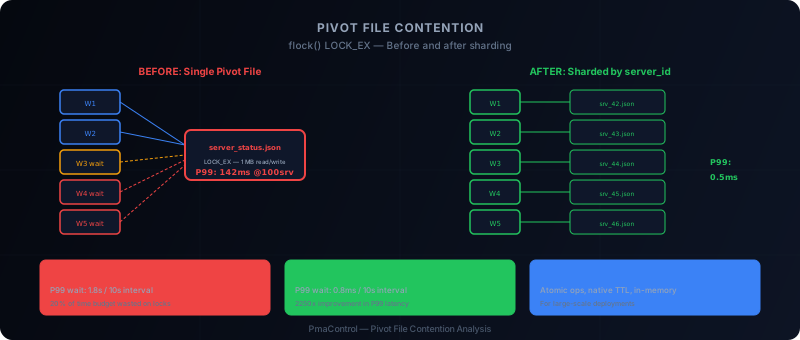
The problem is the server_status.json file. Each daemon worker, after collecting metrics from a server, updates this central file with the new status. The operation:
- Acquire
LOCK_EXonserver_status.json - Read the full content (JSON of all servers)
- Modify the entry for the relevant server
- Rewrite the entire file
- Release the lock
With 10 servers and a 10-second collection interval, this works fine. With 100 servers, the workers start blocking each other waiting for the lock.
Measuring Contention
We instrumented StorageFile to measure the wait time on flock():
$start = microtime(true);
flock($fp, LOCK_EX);
$wait = microtime(true) - $start;
Results with different server counts:
| Server Count | Average flock() Wait | P99 |
|---|---|---|
| 10 | 0.2 ms | 1.1 ms |
| 50 | 4.8 ms | 28 ms |
| 100 | 18 ms | 142 ms |
| 200 | 67 ms | 480 ms |
| 500 | 312 ms | 1.8 s |
Beyond 100 servers, the P99 exceeds 100ms. At 500 servers, some workers wait almost 2 seconds to write a status — on a 10-second collection interval. That is 20% of the time budget spent waiting for a lock.
Why the File Grows
The server_status.json file contains the state of all servers. At 100 servers, it is about 200 KB. At 500 servers, about 1 MB.
Each update:
- Reads 1 MB of JSON
- Parses 1 MB into a PHP structure
- Modifies 2 KB (a single server)
- Serializes 1 MB to JSON
- Writes 1 MB to disk
The ratio is absurd: 2 KB of useful data for 4 MB of I/O.
Solution: Sharding by server_id
The recommendation is to shard the pivot file by server_id:
/var/lib/pmacontrol/pivot/
  status/
    server_42.json    ← 2 KB, a single server
    server_43.json
    server_44.json
    ...
Each worker only needs to lock the file for its server. No more global contention.
Measured Impact
After sharding:
| Server Count | Average flock() Wait | P99 |
|---|---|---|
| 100 | 0.1 ms | 0.5 ms |
| 200 | 0.1 ms | 0.6 ms |
| 500 | 0.2 ms | 0.8 ms |
Contention virtually disappears. Wait time no longer depends on the number of servers but on the number of workers collecting the same server (typically 1).
Trade-off
The dashboard must now read N files instead of one to display the overview. The reading code changes from:
// Before: a single file
$allStatus = json_decode(file_get_contents('pivot/server_status.json'), true);
to:
// After: N files
$allStatus = [];
foreach (glob('pivot/status/server_*.json') as $file) {
    $serverId = extractServerId($file);
    $allStatus[$serverId] = json_decode(file_get_contents($file), true);
}
This is more code, but reading is naturally non-blocking (no LOCK_EX needed for reads thanks to atomic writes via rename()).
Beyond the Filesystem: Redis and memcached
For large deployments (more than 500 servers), the filesystem approach reaches its limits even with sharding:
- I/O latency: each write touches the disk (except for Linux page cache)
- Inode pressure: 500 pivot files = 500 inodes
- No TTL: pivot files for deleted servers remain until manual cleanup
The natural next step is to replace StorageFile with a Redis or memcached backend:
// Abstract interface
interface StorageBackend {
    public function get(string $key): ?array;
    public function set(string $key, array $data, int $ttl = 0): void;
}

// File implementation (current)
class StorageFile implements StorageBackend { ... }

// Redis implementation (future)
class StorageRedis implements StorageBackend { ... }
Redis eliminates contention issues (server-side atomic operations), TTL problems (native expiration), and performance concerns (everything in memory).
Why Not Switch to Redis Immediately
PmaControl was designed to be simple to install: no external dependencies, a single PHP server, no Redis or RabbitMQ. The pivot file approach allows installation on a minimal Debian without prerequisites.
Adding Redis as a mandatory dependency would break this philosophy. The chosen solution is to keep StorageFile as the default backend (with sharding) and offer StorageRedis as an option for large deployments.
Recommendation Summary
| Scale | Recommendation | Backend |
|---|---|---|
| 1-50 servers | Single pivot file | StorageFile |
| 50-200 servers | Sharding by server_id | StorageFile (sharded) |
| 200-500 servers | Sharding + fast SSD | StorageFile (sharded) |
| 500+ servers | Redis / memcached | StorageRedis |
Conclusion
flock() with LOCK_EX works correctly — no silent overwrites. But contention on a pivot file shared by all workers is a real problem beyond 100 servers.
The solution is sharding by server_id: each worker locks its own file, eliminating global contention. For very large deployments, Redis takes over.
The filesystem is not a bad choice for shared memory in PHP. You just need to know when it reaches its limits.
Comments (0)
No comments yet.
Leave a comment