 PmaControl
A Bit of History
MaxScale's licensing history is a microcosm of the tensions between open-source and business in the software industry.
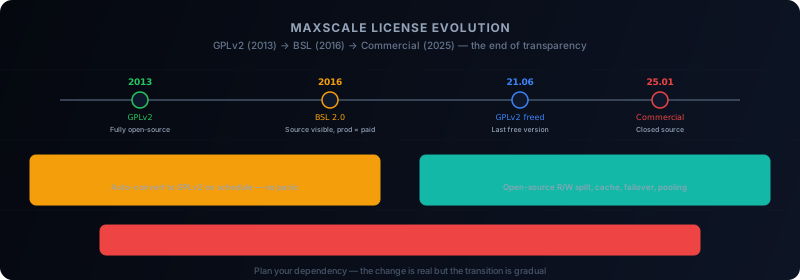
2013-2016: The GPLv2 Era. MaxScale was born under the GPLv2 license. It was an open-source SQL proxy, free to use, modify, and redistribute. The community adopted it, companies integrated it into their MariaDB / MySQL architectures.
2016: The BSL Transition. MariaDB Corporation decided to move MaxScale 2.0 to the Business Source License (BSL). The BSL is an innovative license created by MariaDB: the source code is visible, usable for development and testing, but production use requires a commercial license. After a 3 to 4 year delay, the code automatically converts to GPLv2. An interesting compromise: code transparency + viable business model.
2025: The Pure Commercial Transition. MaxScale 25.01 is published under a closed commercial license. The source code is no longer accessible. The era of transparency is over.
In parallel, MaxScale 21.06 is "freed" under GPLv2 (in accordance with the BSL automatic conversion mechanism). It is the last version that can be used freely, but it will receive no further updates.
What Actually Changes
For current MaxScale users, here is the impact:
BSL Versions (2.x to 24.x)
Existing BSL versions continue to work. The automatic GPLv2 conversion will continue according to the planned schedule — some versions will be freed through 2032. You can continue using these versions in production.
MaxScale 21.06 GPLv2
This is the last fully free version. You can use it, modify it, redistribute it. But it receives no security fixes or new features.
MaxScale 25.01+ Commercial
Every version from 25.01 onward requires a commercial license. No source code access. It is classic proprietary software.
Why This Change?
From MariaDB plc's perspective, the reasoning is pragmatic:
-
MaxScale is a major commercial differentiator. It is what makes MariaDB's Enterprise offering competitive against Oracle and AWS. Giving it away for free (even with a BSL delay) erodes the commercial value proposition.
-
The BSL did not achieve its goals. The original BSL idea was that large companies would pay during the BSL period, and the community would benefit from the freed code after the delay. In practice, many companies simply waited for the GPLv2 release or used older versions.
-
The market has changed. In 2016, the BSL was innovative. In 2025, open-source companies are increasingly adopting restrictive licenses (Redis, MongoDB, Elasticsearch). MariaDB is following the trend.
ProxySQL: The Free Alternative
For users who cannot or do not want to pay a MaxScale license, ProxySQL remains the strongest open-source alternative.
ProxySQL offers much of MaxScale's functionality:
- Read/write routing with automatic topology detection
- Connection pooling and multiplexing
- Query rewriting by regular expressions
- Built-in query cache
- Failover and health checks
- Admin interface via SQL (port 6032)
What ProxySQL does not do (that MaxScale does):
- No MongoDB or CDC/AVRO protocol support
- No Galera monitor as sophisticated as galeramon
- No web interface (MaxGUI)
- No native data masking filter
- No binlog routing support
For the majority of use cases — read/write routing on a MariaDB / MySQL master-slave topology — ProxySQL is a perfectly viable alternative.
The Loss of the BSL Spirit
What bothers me most about this change is not the business aspect. It is the loss of a model that made sense.
The BSL was an elegant compromise. It acknowledged that developing complex software is expensive, while guaranteeing that the code would eventually be free. It was an implicit contract with the community: "pay now for the latest features, and the community will benefit from the code in a few years."
By moving to pure commercial, MariaDB plc breaks this contract. MaxScale 25.01 code will never be free. Transparency disappears. And with it, the trust of part of the community.
MariaDB plc invented the BSL. It was their contribution to the debate on open-source monetization. Abandoning it is acknowledging that the compromise did not work — or that short-term interests take precedence over long-term vision.
What This Means for the Ecosystem
MaxScale's license change is a broader signal for the MariaDB / MySQL ecosystem:
-
Fragmentation is accelerating. The gap between MariaDB Community (free, limited) and MariaDB Enterprise (complete, paid) is widening.
-
ProxySQL gains relevance. Every component MariaDB removes from open-source strengthens community alternatives.
-
Architects must plan. If you build an architecture around MaxScale today, you are building around a proprietary component. Plan your dependency accordingly.
My Advice
If you use MaxScale in production today:
- Stay on your current version as long as it is supported and secure.
- Evaluate ProxySQL as a plan B. Migration is possible, even if it requires work.
- Budget the commercial license if MaxScale is critical to your architecture. It is good software, and the license cost is often lower than the cost of migration.
- Don't panic. BSL versions will be supported for years to come.
The change is real, but the transition is gradual. You have time to plan.
This article was originally published on Medium.
Comments (0)
No comments yet.
Leave a comment