 PmaControl
The Annual Ritual
Every January, the same ritual repeats. Millions of people make resolutions: lose weight, learn a new technology, read more, code a personal project, get a certification. And every February, the vast majority of these resolutions are already forgotten.
This is not a lack of willpower. It is a problem of method.
Why Resolutions Fail
New Year resolutions rest on an illusion: the idea that a calendar change creates behavioral change. "This year will be different" is a magic phrase that allows us to avoid examining why last year was not different.
The real reasons for failure:
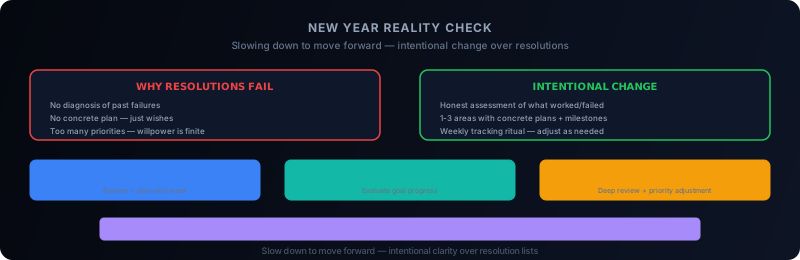
No diagnosis. We set goals without analyzing why previous goals failed. If you did not manage to learn Rust in 2024, starting 2025 by saying "this year, I learn Rust" changes nothing. What stopped you last time? Not enough time? No concrete project to apply it to? No intrinsic motivation?
No plan. "Learn Kubernetes" is not a plan. It is a wish. A plan is: "Every Tuesday and Thursday from 8 PM to 9 PM, I follow X's Kubernetes course. In March, I deploy a personal project on a cluster. In June, I take the CKA certification."
No priorities. We make 10 resolutions when we have the capacity to keep a single one. Willpower is not infinite. Each resolution consumes mental energy. Better one resolution kept than ten resolutions abandoned.
No tracking mechanism. What is not measured is not improved. Without regular tracking (weekly, not annual), resolutions slip into oblivion.
Slow Down to Understand
My proposal is counterintuitive: instead of starting the year at full speed with a list of resolutions, slow down.
Take the time to do a real assessment of the past year:
What Worked
What did you accomplish that you are proud of? Not just the big projects — the small victories too. Every open-source contribution, every bug fixed, every article written, every skill acquired.
What Did Not Work
Be honest. Which goals did you abandon? Why? The reasons are rarely "I am lazy." They are more often "I did not find the time," "the project did not really interest me," or "I underestimated the difficulty."
What Changed
Your January priorities are not your December priorities. Life evolves. A job change, a child, a move, an illness — these events reconfigure your capacities and your desires. Accepting this change is the first step toward realistic goals.
Mental Space
John Maxwell writes that most people live their lives by accident rather than by intention. They react to events instead of creating them. They endure their schedule instead of designing it.
Creating mental space for reflection is essential. Not one day per year (December 31st). A regular ritual:
- Weekly: 30 minutes on Sunday evening to review the week and plan the next one
- Monthly: 1 hour to evaluate progress toward goals
- Quarterly: half a day for a deep assessment and priority adjustment
This is not obsessive productivity. It is intentional clarity.
How I Do My Assessment
Here is my method, simple and reproducible:
- List the accomplishments of the year. Everything, unfiltered. Even the small ones.
- List the failures and abandonments. Without judgment. Just the facts.
- For each failure, identify the root cause. Not "lack of motivation" (that is a symptom), but the real cause.
- Identify 1 to 3 areas to invest in this year. Not 10. One to three.
- For each area, create a concrete plan with monthly milestones.
- Define a tracking ritual (weekly preferred).
Intentional Change
Real change does not come from a New Year resolution. It comes from an intentional decision, supported by a plan, regularly tracked, and adjusted when reality demands it.
It is less romantic than a resolution list written at midnight with a glass of champagne. It is infinitely more effective.
Slowing down to reflect is not wasting time. It is investing time in direction. Because running fast in the wrong direction is worse than walking slowly in the right one.
Conclusion
Do not make resolutions. Make an assessment. Identify what matters. Build a plan. Follow it. Adjust it.
Slow down to move forward.
This article was originally published on Medium.
Comments (0)
No comments yet.
Leave a comment